Tuesday, 31 August 2010

The Mad Piper of D-Day

Bill Millin, "the Mad Piper of D-Day," died in Britain earlier this month at age 88. During World War II, the young soldier and bagpiper served in the regiment of Lord Lovat, the commander of the British D-Day troops who landed with the Allies on the beaches of Normandy.

On the fateful morning of June 6, 1944, the 21-year-old Private Millin waded ashore under heavy fire with the other troops, his kilt floating up around him in the waist-high water. But instead of a gun, he held his bagpipes above his head so they wouldn't get wet. There's a famous photo of him disembarking, the drones of his pipes visible in front of his face --


Although playing bagpipes in battle was strictly forbidden by the War Office, Lord Lovat had the unarmed private march up and down Sword Beach, piping Highland Laddie and Road to the Isles as a morale booster while soldiers all around him advanced or were mowed down in the German artillery and machine-gun fire. As Bill Millin said decades later, with amazing understatement, "When you're young, you do things you wouldn't dream of doing when you're older. I enjoyed playing the pipes, but I didn't notice that I was being shot at."

It was truly a miracle that he survived. German prisoners of war captured at Sword Beach subsequently said that the Germans didn't kill him simply because they thought he was insane. That's how he earned his nickname of "the Mad Piper."

There's a great YouTube video about Bill Millin if you want to check it out, complete with an interview about the day that made him a legend.

May a thousand piobaireachd (laments) be piped in his honour.

Monday, 30 August 2010

The Salmon of Wisdom


In traditional Celtic myth, an ordinary salmon ate nine sacred hazel nuts which fell into the pool where it lived and so was magically transformed into the Salmon of Wisdom.

I prefer the re-visioning of this myth by Patricia Monaghan in her book, The Red-Haired Girl from the Bog (2003):

I understand why the ancient Irish saw wisdom as a salmon . . . . Who is wiser than one who knows the way home?

What natural phenomenon is more mysterious and compelling than salmon who return from the ocean, years later and against impossible odds, to spawn and die in the very same stream where they were born?

As Rabbi Seymour Siegel wrote:

In everyone's heart stirs a great homesickness . . . .

We are all called by the deepest yearning of our hearts to be Salmon of Wisdom.

Saturday, 28 August 2010

Cats in the News (#3)

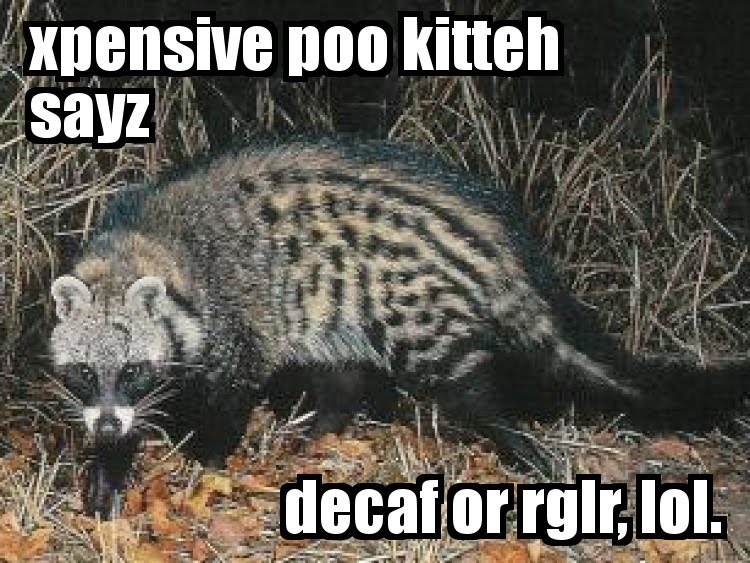
OMG, the Globe and Mail has just published some late-breaking news about cat poop coffee!

Because crappuccino has now been declared halal for Muslims, some producers are planning to meet increased demand by domesticating wild civet cats, breeding them in cages and farming their coffee-bean-studded poop. But experts warn that this will result in less flavourful coffee. The varied diet of wild civet cats is necessary to produce the special stomach enzyme which processes the coffee bean fruit during digestion. A regulated diet will produce a "monotonous enzyme" and therefore, a different taste for the coffee.

Run, little civet cats! Hide! Protect the high quality of your poop from the greedy entrepreneurs!

Friday, 27 August 2010

Cats in the News (#2) (hee, hee, hee)


I know everyone has heard of that incredibly expensive coffee known colloquially as "cat poop coffee" (or sometimes as "crappuccino" LOL). In the rainforests of south-east Asia, wild civet cats eat a certain kind of coffee bean fruit, digest the fruit and then poop out the undigested coffee beans. This natural "processing" results in delicious coffee, apparently, once the beans are washed and roasted. A pound of this rare coffee can cost hundreds of dollars. It must be worth it, though -- the coffee company's logo says that it's "good to the last dropping!"


Recently, civet cat coffee was declared halal (religiously approved) for Muslims to drink, so long as the beans were thoroughly washed. This is a good thing since probably only oil sheiks can afford to buy this coffee on a regular basis.

However, it does not appear that civet cat coffee is kosher (religiously approved) for Jews to drink. Since Jewish dietary laws prohibit consumption of a certain flavour-enhancer additive derived from the glands of civet cats, it seems doubtful that coffee processed by the same animal would be given the green light.

For the rest of us, the only restrictions on consumption are our wallets, our taste buds and our sense of adventure!

Wednesday, 25 August 2010

Cats in England

One more thing about England -- I expected to see lots of cats there. We saw oodles of cats when we were in Italy the year before. In fact, I milked the topic for three whole blog posts (here, here and here if you're interested). And aren't the English supposed to adore cats?

This is the only cat we saw in Glastonbury, sitting on the stoop of a house leading up Wearyall Hill. Yes, precisely, a FAKE one.

The ONLY real cat we saw in all of England was this cheeky little bugger sharpening its claws on someone's car tires in Avebury. Or perhaps I should say tyres in the English way . . . .

And of course, THIS is what I had HOPED to see . . . .


[First two photos by my Rare One, taken at my insistence]

Tuesday, 24 August 2010

Stonehenge, Part 4


I have now been to both Stonehenge and St. Peter's Basilica in Rome.

The two sacred sites have much in common. Each celebrates the Divine. Each has drawn pilgrims, seekers and the curious for millenia. Both have huge, awe-inducing structures designed to tower over and subdue the egos of those who enter that space.

But here is where they differ -- Stonehenge sits open to the elements and, imposing though its stones may be, graphically reminds us that its stones are themselves dwarfed by the true power and divinity of the Earth. By contrast, St. Peter's is enclosed against the elements, its magnificent glories all man-made. It may indeed point to its own transcendent truth, but that truth is not Nature. A building seeks to contain. An open-air temple simply seeks to acknowledge which is why, for me, Stonehenge radiates more spiritual power.

Monday, 23 August 2010

Stonehenge, Part 3

We entered Stonehenge in ritual procession. Mara Freeman, an Archdruidess of the Irish Druid Clan of Dana, led us in spiral formation to the centre of the great stones. There was silence except for the sound of her ringing bell. We called the Quarters and their guardians: the Hawk of Dawn (east), the Salmon of Wisdom (west), the Great Bear (north) and the Great Stag (south).

There was a special invocation of the Goddess and a celebration of Autumn's blessings. Then we were free to move about the stones, explore the site and take photos for half an hour before resuming the ritual.

The National Trust's rules for those who enter Stonehenge are strict, of course. You may touch the stones but not climb them or sit on the fallen ones. Obviously nothing can be done to mar or deface the stones or the site. No foreign objects may be left behind.

What can I say about the stones? They are everything you would imagine them to be. Huge, imposing, solemn, full of energy. They glowed in the setting sun. Our shadows and theirs were long and dark against the earth.

We found a megalith with a sacred yoni at its base . . .


. . . and one that was either pursing its lips disapprovingly or holding in a big guffaw . . . we couldn't tell which?

Resuming our ritual, Mara led us in a meditation giving thanks to the Earth Mother. She followed this with a special and very beautiful blessing ceremony using water from the Chalice Well in Glastonbury. After chanting the ancient Druidic chant of Awen, we thanked and closed the Quarters. Our ritual ended just as the sun was slipping past the horizon. We spiraled out of Stonehenge as we had entered, silent except for Mara's ringing bell.


We waited on the paved pathway while two security guards went over the site with a fine-toothed comb to make sure everything was all right. An artist among us who had been sketching the stones had inadvertently dropped a pen. They found it. Otherwise, we left Stonehenge undisturbed!

Tomorrow -- some last thoughts about Stonehenge . . . .

[All photos by my Rare One. Isn't the sunset shot wonderful?]