

Monday, 6 September 2010

Friday, 3 September 2010
Pagan Labyrinths

The Cretan (or Minoan) labyrinth is the oldest form of labyrinth. It comes from the ancient Goddess-centred Minoan civilization which once flourished on the island of Crete in the Mediterranean Sea. This labyrinth is sacred to the Great Goddess, as evidenced by its circular shape (a central symbol of the Divine Feminine). The four rounded turns within the labyrinth are known as "the breasts of the Goddess."
How does this labyrinth's unicursal nature fit with the ancient Greek myth of the Minotaur? The Cretan priestess Ariadne gave a ball of red yarn to the Athenian hero Theseus so he could trace his way into the labyrinth, kill the Minotaur at its centre and then safely find his way out again. That's a description of a maze, not a true labyrinth.

I think the myth we know today is a later patriarchal version interpreting (and distorting) much older symbolism. We know that bulls were sacred to the Goddess in ancient Crete. "Minotaur" means "moon bull" so it was probably a revered symbol of the Divine Feminine in Crete's early days. In the myth's patriarchal version, the Minotaur becomes a symbol of death and evil which must be slain. Scholars also believe that Ariadne was originally the Great Goddess Herself but was downgraded in the patriarchal myth to simply being the daughter of the King and a priestess in the temple. She betrays her people and her religion to help Theseus, who callously uses and deserts her.
So, given these later patriarchal distortions, it's not really surprising that a unicursal labyrinth gets recast as a multicursal maze. It moves the plot along, creates suspense and sets the context for Ariadne's betrayal. In fact, this Greek myth as a whole may be understood as a metaphor for the ascendancy of patriarchal culture over the Goddess-centred culture which preceded it.
Now that the Divine Feminine is being actively revered again in the western world, walking Her labyrinth has become a popular expression of Goddess spirituality and devotion among pagans.
We tread Her sacred path once more.
Thursday, 2 September 2010
Labyrinths Are Not Mazes

Many people use the words "labyrinth" and "maze" interchangeably. But they are not the same thing at all.
A maze is deliberately designed to fool and confuse the walker. There are twists, turns, dead ends. You can get lost in a maze. A maze is multicursal -- it has multiple paths but only one path gets you to the destination. A maze is a puzzle to be figured out.
But you can never get lost in a labyrinth because it only has one path. The path may twist and turn, but there are no dead ends or misleading alleyways. A labyrinth is unicursal -- it has a single path that leads to the centre and back again.
That's why a labyrinth can be used for meditation -- you don't have to use your left brain to figure out the correct path. Knowing that you cannot get lost, you can turn off your left brain. Your right brain is then free to take over and conduct a truly meditative experience for you.
Wednesday, 1 September 2010
Labyrinths: Walking the Sacred Path

The popularity of walking a labyrinth as a spiritual exercise has enjoyed an amazing resurgence over the past 15 years or so in both the Pagan and Christian communities. I first experienced the power of a labyrinth on the Summer Solstice in 1997 and immediately fell in love with this ancient form of walking meditation. Since then, I have walked many labyrinths -- some close to home and some far afield. I'd like to share some of my favourites with you so I'm starting this new series of blog posts discussing labyrinths I have known and loved. As usual, the series will not be sequential and there may well be gaps between postings on this particular subject. But come along with me anyway and together we'll walk the sacred path!


Tuesday, 31 August 2010
The Mad Piper of D-Day

Bill Millin, "the Mad Piper of D-Day," died in Britain earlier this month at age 88. During World War II, the young soldier and bagpiper served in the regiment of Lord Lovat, the commander of the British D-Day troops who landed with the Allies on the beaches of Normandy.
On the fateful morning of June 6, 1944, the 21-year-old Private Millin waded ashore under heavy fire with the other troops, his kilt floating up around him in the waist-high water. But instead of a gun, he held his bagpipes above his head so they wouldn't get wet. There's a famous photo of him disembarking, the drones of his pipes visible in front of his face --

Although playing bagpipes in battle was strictly forbidden by the War Office, Lord Lovat had the unarmed private march up and down Sword Beach, piping Highland Laddie and Road to the Isles as a morale booster while soldiers all around him advanced or were mowed down in the German artillery and machine-gun fire. As Bill Millin said decades later, with amazing understatement, "When you're young, you do things you wouldn't dream of doing when you're older. I enjoyed playing the pipes, but I didn't notice that I was being shot at."
It was truly a miracle that he survived. German prisoners of war captured at Sword Beach subsequently said that the Germans didn't kill him simply because they thought he was insane. That's how he earned his nickname of "the Mad Piper."
There's a great YouTube video about Bill Millin if you want to check it out, complete with an interview about the day that made him a legend.
May a thousand piobaireachd (laments) be piped in his honour.
Monday, 30 August 2010
The Salmon of Wisdom

In traditional Celtic myth, an ordinary salmon ate nine sacred hazel nuts which fell into the pool where it lived and so was magically transformed into the Salmon of Wisdom.
I prefer the re-visioning of this myth by Patricia Monaghan in her book, The Red-Haired Girl from the Bog (2003):
I understand why the ancient Irish saw wisdom as a salmon . . . . Who is wiser than one who knows the way home?
What natural phenomenon is more mysterious and compelling than salmon who return from the ocean, years later and against impossible odds, to spawn and die in the very same stream where they were born?
As Rabbi Seymour Siegel wrote:
In everyone's heart stirs a great homesickness . . . .
We are all called by the deepest yearning of our hearts to be Salmon of Wisdom.
Saturday, 28 August 2010
Cats in the News (#3)
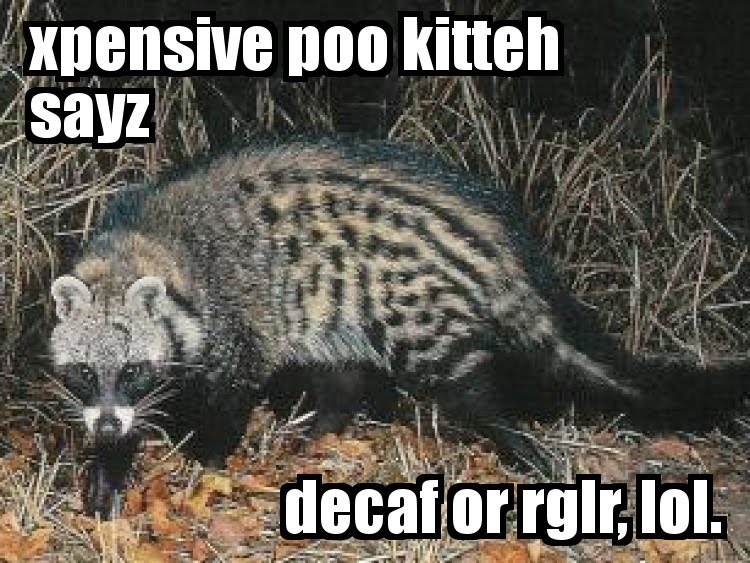
OMG, the Globe and Mail has just published some late-breaking news about cat poop coffee!
Because crappuccino has now been declared halal for Muslims, some producers are planning to meet increased demand by domesticating wild civet cats, breeding them in cages and farming their coffee-bean-studded poop. But experts warn that this will result in less flavourful coffee. The varied diet of wild civet cats is necessary to produce the special stomach enzyme which processes the coffee bean fruit during digestion. A regulated diet will produce a "monotonous enzyme" and therefore, a different taste for the coffee.
Run, little civet cats! Hide! Protect the high quality of your poop from the greedy entrepreneurs!
Subscribe to:
Posts (Atom)